
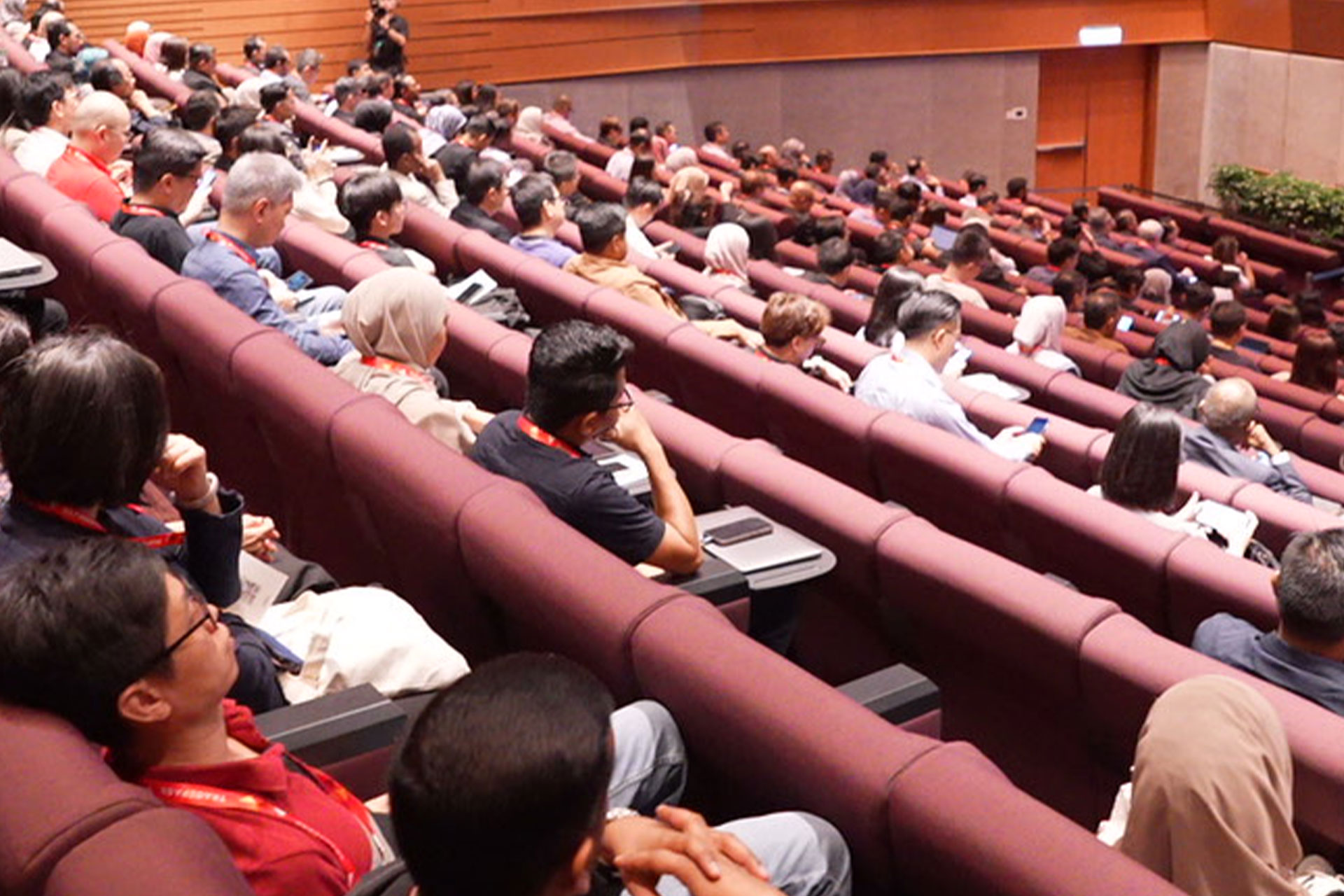
What are your key objectives for attending the DCCI Expo in Malaysia? How does it align with your broader mission around cloud transformation and enterprise AI adoption in the region?
Malaysia is at a genuine inflection point. The combination of large-scale hyperscaler investment in regional data centre infrastructure, a government actively pushing digital transformation, and enterprises increasingly ready to act on AI adoption creates a market moment that doesn’t come around often. DCCI is where that conversation is happening at the highest level, and that’s exactly why we are here.
Our objectives are threefold. First, we want to connect with enterprise organisations that are navigating the transition from cloud adoption to cloud optimisation — organisations that have made the infrastructure investment and are now asking how to get more from it. Second, we see significant opportunity in the AI readiness conversation — helping organisations understand what strong data and cloud foundations actually need to look like before AI can deliver real business value. Third, Malaysia is a strategic market for Virtasant’s APAC expansion, and DCCI gives us the platform to build the kind of senior relationships that translate into long-term partnerships rather than transactional engagements.
More broadly, this aligns directly with what we’re seeing across the region. As Google Cloud and other hyperscalers deepen their footprint in Southeast Asia, the opportunity for organisations to leverage that infrastructure grows — but so does the complexity of managing it efficiently. That’s the space Virtasant is built for, and Malaysia is one of the markets where we see the strongest near-term demand.
ReadYou’ve been recognized as an AWS Cloud Operations Competency Launch Partner. What capabilities, would you say, led to this recognition? In addition, how do your curated partners support you to deliver value to clients globally?
We partner with many of the world’s leading technology companies, including AWS, Google, Microsoft, Mistral, and Databricks. Our partnerships with these and many other leading global technology companies give us access to some of the world’s best technology, as well as the training, access, and expertise to ensure that our clients not only get the best technology in the world at the best price, but that they get the most value out of their use of this technology.
Our core team and global network have deep expertise in these technologies and the methods that maximize value for organisations leveraging these technologies. Our partnerships allow us to have access to the latest products, the best information, and training to continuously deepen our skills and capabilities. All of this means that our clients get the most out of their investments, with faster time to market and lower total cost of ownership.
ReadVirtasant combines proprietary automation tools with a global network of cloud professionals. How does this hybrid model compare to traditional consulting or outsourcing firms in terms of speed, scalability, and innovation?
Traditional consulting firms are built around a fundamental constraint: geography. Their model assumes that the best person for your engagement is whoever is available in your city, at your price point, within their local bench. Outsourcing firms solve the cost problem but often introduce a different one — generic delivery, high turnover, and a race to the bottom on rates rather than a focus on outcomes.
Virtasant is built differently. We operate on a remote-first, globalised model, which means we assemble the right team for each client’s specific challenge — not the nearest available one. In practice, that means a client in Kuala Lumpur or Sydney can access specialists who have solved that exact problem before, regardless of where they’re based. Whether that’s a complex cloud migration, a greenfield AI build, or an ongoing managed services engagement, the calibre of the team doesn’t vary by location.
That model also enables something traditional firms structurally can’t offer: 24/5 development squads. Because our teams span time zones by design, work continues around the clock — which compresses delivery timelines in a way that a locally-anchored team simply cannot match. For clients under pressure to move quickly, that’s a meaningful difference.
On scalability, the global talent model means we’re not capacity-constrained in the way a traditional firm is. We don’t need to hire locally to grow a client engagement — we can bring in the right capability, at the right moment, without the overhead of building a regional bench first.
Innovation comes from that same depth of access. Our people have worked across cloud deployments, data platforms, and AI implementations at scale — across industries and geographies — and that cross-pollination of experience is what drives better thinking in engagements, rather than recycled playbooks built for a different client’s problem.
The model we’re building reflects a simple proposition: outcomes should be the only thing consultancies are measured on, and geography should never be the reason a client gets a suboptimal team.
ReadVirtasant claims to help companies reduce cloud spend by over 50% through automation and optimisation. What are the key technical or operational levers that enable such significant savings, and how do you sustain those efficiencies over time?
At Virtasant, we’ve always believed that the only metric that matters is outcomes — not activity, not recommendations, not reports. That philosophy shapes everything about how we approach cloud cost optimisation.
Our solution goes far beyond the basics, such as rightsizing underutilised resources and eliminating idle resources, and allows an organisation to truly understand the total efficiency of their technology footprint, telling them exactly how much they are actually using of every dollar of spend. From there, we give organisations details on not just the basics, but advanced optimisations including Kubernetes, GPU, and AI infrastructure, all tailored to the exact context of an organisation and its individual applications and solutions.
Having complete visibility and a detailed understanding of what to do in order to reduce spend is only half the battle. The real challenge is getting engineers to take action. This is where our holistic model, combining the world’s leading optimisation technology combined with our global team of forward-deployed engineers that work directly with organisations and their engineers, makes all the difference. We go beyond systematic recommendations to apply context, understand your priorities, and work directly with teams to implement the changes needed to maximize efficiency.
To do that at scale, we developed Helias — our proprietary FinOps and technology cost optimisation platform. Helias ingests cost and utilisation data in real time across cloud, on-premises, data warehouse, and AI workloads, and applies purpose-built AI agents to assess actual utilisation of each asset over time. That granularity is what allows us to calculate rightsizing opportunities with precision, rather than working from averages or estimates.
What sustains the savings over time is the “always on” nature of the platform. As new workloads are deployed, Helias tracks their utilisation patterns and flags optimisation opportunities continuously — not just at a point-in-time assessment. That’s paired with our forward-deployed engineers and FinOps experts, who work directly with client teams to drive the organisational change needed to make sure efficiency gains stick rather than erode as environments evolve.
ReadHow has Virtasant’s global team consisting of a network of over 50,000 professionals across 130 countries evolved since the company’s founding?
The public cloud and the adoption of cloud and AI has fundamentally changed how organisations think about technology — and we’ve had a front-row seat to that change working with some of the largest companies in the world.
In the early days, the dominant conversation was around hesitancy: data sovereignty concerns, security uncertainty, and a general reluctance to move critical workloads off-premise. What we’ve seen since is a decisive swing in the other direction, as hyperscalers have matured their security layers, compliance frameworks, and service depth to the point where the cloud is now the default assumption, not the exception.
More recently, AI has added an entirely new dimension. It has opened up the capability of data directly to business teams — not just technical ones — which means the foundations organisations have built in the cloud now carry far greater strategic weight. Security and data architecture decisions that once felt like infrastructure hygiene are now directly tied to how effectively a business can deploy AI.
With the incredible pace of change occurring in the market today, thanks to AI, the ability of an organisation to rapidly evolve technology by leveraging the power of the public cloud has moved from a strategic advantage to a matter of survival. Organisations that don’t leverage AI effectively in every single aspect of their organisation will not be able to compete, and the only way to leverage AI at the speed required is to have a holistic, business-aligned cloud capability that allows you to deploy AI rapidly and that securely, efficiently, and reliably unlocks the power of all of an organisation’s data and knowledge.
Read