

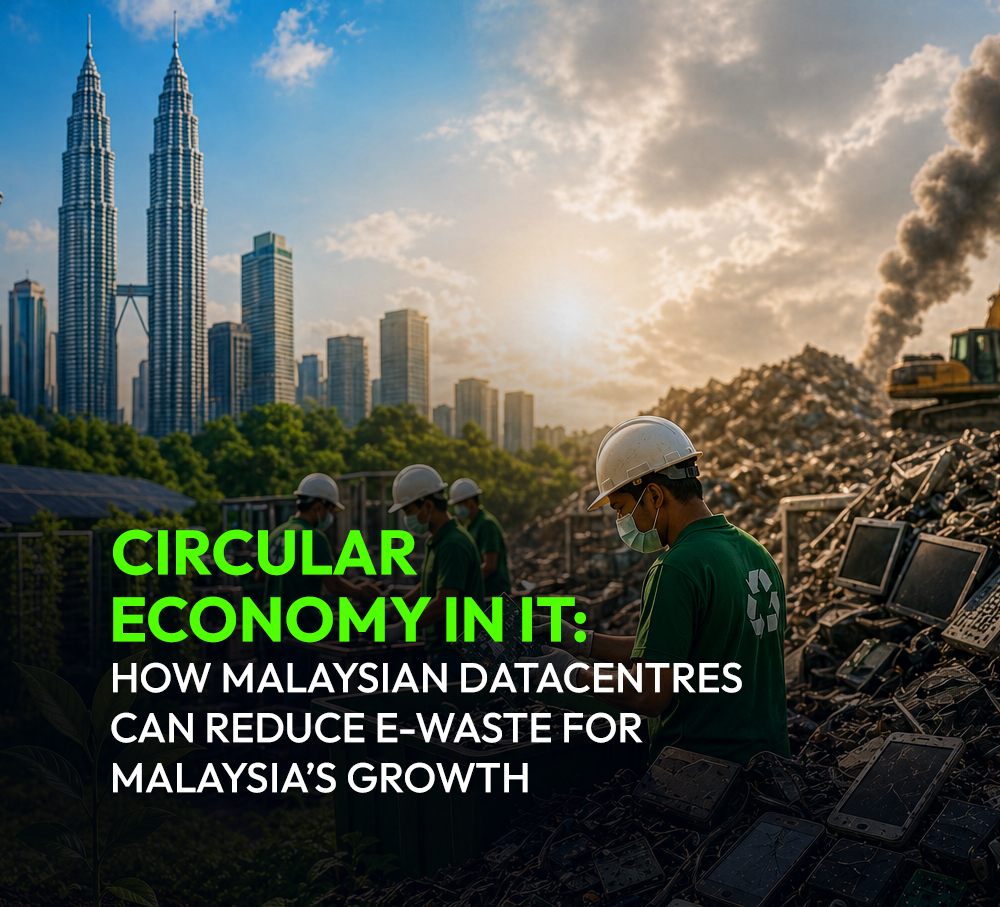
Malaysian datacentres play a central role in the growth of the nation’s digital economy. The sector almost reached 25% of GDP in 2025. Yet fast growth creates a problem. Electronic waste piles up from servers and other gear replaced every few years. The circular economy changes the old linear path of “make, use, and discard”. It turns it into reuse and recovery. Operators extend hardware life. They refurbish parts and recover materials. This cuts waste and supports growth. It leads to sustainable datacentres that use fewer resources. These align with national emission goals.
Overview of E-Waste Challenges in Malaysian Datacentres
Rising Issue
Global e-waste hit 62 million tonnes in 2022. It grows quicker than recycling efforts can match. Datacentres refresh hardware often for cloud and AI demands. Servers last three to five years. Replacement occurs even if they function. Circuit boards and metals go to waste without recovery.
Malaysia Context
Malaysia exceeds the global e-waste average. It produced 12.2 kilograms per person in 2022. The world average was 7.8 kilograms. In 2025, the Department of Environment expected 24.5 million units.
Datacentre Specifics
Over 100 projects operate in Johor and the Klang Valley. IT load exceeds 1.7 gigawatts. Demand may hit 5,000 megawatts by 2035. Each site uses thousands of servers and cooling units. End of life creates large volumes of discarded hardware.
Policy Landscape
The Environmental Quality Act covers industrial e-waste. Household waste is harder to manage. Blueprints call for producer responsibility and resource loops. A framework for datacentres is being developed. Reporting on energy and waste may become required. Operators often use voluntary steps only.
Opportunity
Growth creates scale for solutions. Steady used equipment supports refurbishment and recovery. Refurbished servers and metals lower costs.
Applying Circular Economy Principles to Datacentres
Core Principles
Circular practices rest on three ideas. Keep products and materials in use at their highest value. Design out waste from the start. Regenerate natural systems where possible. In datacentres, this means servers and racks become assets for repair, upgrade, or breakdown into usable parts.
Server Lifecycle Management
Operators extend server life by upgrading individual components, such as memory or storage. Full replacement is avoided. Facilities track utilisation rates and retire only low performers. Predictive maintenance tools help spot failing parts early. Repairs happen before full replacement.
Refurbishment and Resale
Refurbished servers find ready buyers in secondary markets. Smaller enterprises and regional cloud providers seek them. Certified processes clean, test, and upgrade hardware to meet original performance standards. Partnerships with local IT asset disposition firms already handle thousands of units each year in Malaysia. Scaling these channels lets datacentres recover capital from used gear.
Material Recovery
Circuit boards contain gold, copper, and rare earth elements that lose value if sent to a landfill. Formal recovery lines use mechanical shredding followed by separation. Recovered metals return to electronics manufacturers. Malaysian recyclers can process datacentre volumes when collections are reliable.
Waste Heat and Resource Loops
Datacentres reject large amounts of heat. In a circular model, this heat warms nearby buildings, greenhouses, or industrial processes. Water used for cooling can be treated and reused. These loops lower overall resource demand. They support carbon neutral data centres.
Compliance and Standards
International guidelines and local alignment with the National Energy Transition Roadmap give clear targets. Reporting on material recovery rates and extended product life becomes part of ESG disclosures. Facilities that meet these benchmarks often qualify for incentives under existing green technology schemes.
Practical Steps for Malaysian Datacentres to Implement Circular Practices
Audit and Plan
Start with a full inventory of IT assets. Include age, condition, and utilisation data. Map refresh cycles for the next three years. This baseline shows recoverable equipment volumes. A clear plan sets recovery targets.
Partner Selection
Select vendors with proven records in secure data destruction. Certified refurbishment is key. Local firms hold Department of Environment licences. They meet international data wiping standards. Transparent reporting on material flows follows.
Hardware Strategies
Buy modular servers for easy upgrades. Avoid full replacements. Add take-back clauses in supplier agreements. Pilot certified refurbished units for non-critical work. These choices lower capital costs.
On-Site Measures
Create areas for sorting decommissioned hardware. Basic repairs happen there. Train technicians to spot reusable components. Install tracking systems. Log each server’s journey from service to recovery.
Tracking and Reporting
Digital platforms record recovery volumes. Material reuse percentages and cost savings appear, too. Quarterly summaries go to regulators and stakeholders. Metrics cover tonnes diverted from landfill. They show percentage of servers extended beyond design life.
Scaling Up
Pilot projects succeed first. Practices then expand to all facilities. Integrate circular requirements into procurement. Collaborate with peers for shared refurbishment hubs.
Malaysia-Specific Opportunities and Strategies
Leverage Hubs
Johor sits near Singapore. Its cluster of hyperscale projects makes a good test bed for pilots. Industrial parks can host shared recovery centres.
Policy Incentives
Tax breaks under the Green Investment Tax Allowance reward circular measures. The Malaysian Investment Development Authority offers support. New guidelines tie approvals to waste reduction targets.
Collaboration Paths
Public-private partnerships with the Malaysian Green Technology and Climate Change Corporation speed technology transfer.
Green Alignment
Circular practices match the National Energy Transition Roadmap. They push sustainable IT infrastructure. Reuse of heat or metals aids national decarbonisation.
Strategic Edge
Leaders in circular methods gain an advantage. International clients want verified low-waste chains. Malaysia becomes a preferred spot for responsible digital investment.
Shape Malaysia’s Sustainable Datacentre Future at DCCI 2026
The upcoming DCCI Expo Malaysia event gathers operators, policymakers, and technology providers to examine practical ways forward. Discussions will focus on real examples of sustainable IT infrastructure and circular methods already working in local conditions. Participants can share challenges, explore partnerships for waste-heat projects, and review the latest tools for tracking recovery rates.
The platform offers direct access to experts who understand both technical requirements and national priorities. The conversations at DCCI 2026 will guide the next steps toward carbon neutral data centres that reduce e-waste while driving Malaysia’s economic expansion for years ahead.